Showing posts with label conference. Show all posts

Friday, January 30, 2015

Agile Practitioners 2015

After last year's conference, the guys from Practical Agile decided to "open source" the conference - the conference was community driven by a volunteering steering team. This year the conference offered a full 4-track program under the title "learn something new" making it harder than ever to choose the sessions.


Keynote: Unicorns, krakens and self-organized-teams

a delegation board
A slimmer version of Angel Medinilla (@angel_m) returned to get things going with his high paced, humorously sketched view on the road (and pitfalls) to hyper-performing teams. Some of the notions come from management 3.0 which is not a coincidence, as Angel is one of the M 3.0 trainers. Some topics to follow up on may be the Agile Fluency Model, the "Agile Kaizen" book and delegation boards.

Morning Sessions

Gil on #NoEstimate
Gil Zilberfeld's talk, “To Estimate or #NoEstimate” talked about the #NoEstimate movement, why people want estimates, what are the problems with estimates and what could be useful alternatives.
Meanwhile I missed, among others, Uri Nativ's "Missing Lecture" about the difficult-to-deal-with gap between the agile coach/leader's perspective and the teams' view on the agile change initiative. I love the slides (form and content).


Next, Lior Friedman, talked about code smells, and their less (in)famous cousins: Test Smells. Learning to identify them can help improve the system. After all, TDD is a way to write well designed software. Problems in the tests often tell you of problems in the design, or even in your process.

Afternoon Sessions

Three short sessions:
One of Barak's slides

  • Gull Ben-David (from MyHeritage) shared why QA people make good scrum masters
  • Ran Deri and Noam Zweig (from CyberArk) gave some insight on their experience dealing with Technical Debt systematically. Interesting mix of tools (such as sonar) and assessment (using a survey by Gil Broza) to actually track, negotiate budget and set goals.
  • Barak Benjo (Cisco) gave tips for Agile Testing in a legacy environment


In a session I missed, Yuval Yeret (happy birthday!) gave a talk about an effective way for managing an agile transformation.


"Lean Lens" - observing our results
Andrea Darabos conducted her "Lean Lens" workshop. It is essentially a role playing game each team gets a scenario to play out. Some participants act, simulating the different roles, while others observe, trying to identify the 8 types of waste (better known as the 7 wastes + unused skills).
You can download the game here (developed by  and )
Interesting takeaway - try set up a board in the team room to collect instances of the 8 wastes as they happen, and deal with them in the retrospective. Hey - these are "process smells"!

Meanwhile, Eyal Golan talked about working with legacy code. I was told it was interesting and practical.

The last track session actually had 5 options, because Angel agreed to give an improvised sketching workshop where we practices some basic shapes, faces, stick men, containers, call-outs, etc. That was fun, and it was similar to some of Angel's Drawing 101.
More advanced stuff can be found in learning to sketch on tumblr.

Closing keynote: Claudio Perrone on Popcorn Flow and A3 thinking

Claudio, a.k.a Agile Sensei, described his A3 thinking / problem solving system, and POPCORN flow, which is a kanban board for capturing, planning and tracking change experiments.
Slides here (well, very similar to the ones he actually used). Another interesting concept he described was "job to be done" (JTBD) as an alternative to user stories formulation, focusing on the human need you wish to fulfill. As an intro to the topic, Alan Klement's description of a "job story" is very useful.

There was much more, obviously, but that's what I can share. Great stuff, community!
You can find more here:

  • Dror Helper's impressions of the conference here
  • Gil Zilberfeld shares some stats (and a creepy photo holding Dalia's disembodied head)
  • Twitter handle: #APIL15

Tuesday, March 4, 2014

Software AG at Agile India 2014


On January 2013 I had the great experience of sharing in Israel some of what we learned at Software AG during our ongoing road to Lean and Agile, and I know of a couple of other colleagues who presented at other conferences.

Last week, Bangalore hosted the Agile India 2014 conference. Four days packed with speakers from all over India, and many international speakers. This time, my colleague Harish Krishnaswamy was presenting a very different perspective of our story. You can find the slides here, or read the full experience report which is packed with information and inspiring data of the significant impact of the transformation. I recommend to people interested in large scale transformations - read the report. Harish did a great job collecting information and interviewing many people in different roles regarding the journey. I'm sure people of Software AG would find it interesting to read a story they played a role in from a different, more holistic perspective.

An impressive amount of four more Software AG employees gave lightning talks: Amit Deshpande, Heartin Jacob, Chandan Ravishankar and Ramya Gopalakrishnan.

Amit spoke of Scrumban, a combination of Scrum and Kanban which can be used in those circumstances where you have a mix of feature development and technical debt/customer issues. In particular customer issues or unplanned events that could be disruptive to the planned work in a sprint.

Heartin blogged on the topic of his talk: what success means in Agile and how Agile helps us to be successful, highlighting the strong bond linking technical and organizational success with the personal success of individual contributors. 

Chandan asked why are you following Agile? The key point is that following the practices becomes an empty shell without being a part of the transition, caring and having personal engagement with the work you do (aligned with Heartin's theme). Another is the point that agile practices are designed to keep you honest about what you can deliver on a sustainable pace, and encourage you to aim higher based on the current reality and your history.

Ramya talked of using WIP limits to reduce Context Switching, sharing the specific context and behaviors the team adopted to deal with complexity, reduce stress and maximize learning and collaboration. I'm not sure how common it is to do an exercise with the audience demonstrating context switching in a five minute lightning talk and still have time to say something - wow!

Such evidence strengthens my belief that the transformation we're going through at Software AG runs deep - many individuals align with it and contribute well beyond their job description for the success of the organization, for technical excellence and in support of their own growth.


Wednesday, February 5, 2014

Agile Practitioners 2014 Conference Impressions

I know Lior, Elad and Ilan, a.k.a. Practical Agile, for a while now. I had the opportunity to speak in the Agile users group they organize (and attends sessions) and also to speak on last year's conference. There were also workshops and other activities, including the unforgettable Coach Retreat Tel Aviv with Yves Hanoulle. 
Board Exhibition

This year's Agile Practitioners conference had 3 tracks to choose sessions from, other than the key notes. 
The venue was a good match to the needs. I liked the exhibition of team boards arranged by Amit Yedidia. I also liked the feedback green boxes and the feedback notes: they were small enough to make you give short comments, and it was phrased to get positive comments and things to improve.

Keynote by Jutta Eckstein

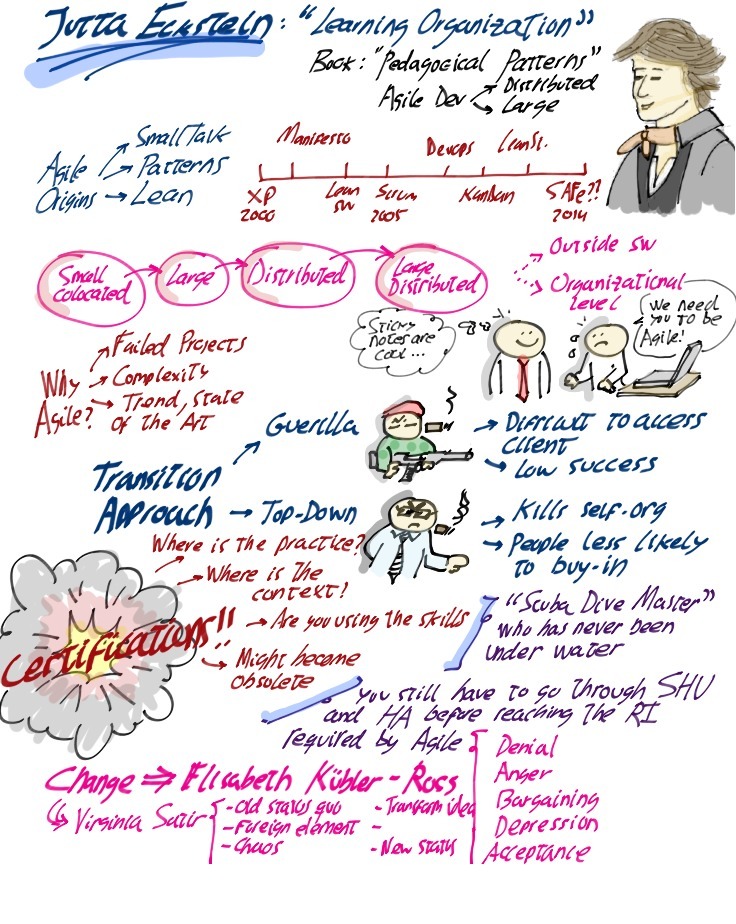
Jutta Eckstein gave the opening keynote, "Towards a learning organization". She started with her view on the origins of agile: Toyota, the SmallTalk community and Patterns (architecture and process) and identified a shift in application focus from smaller teams to larger and distributed organizations, and extending outside software development over time. 
Jutta Ecktein's key note
Different adoption strategies hold different risks. Specifically, top-down approaches tend to rely on certifications, which may ensure some knowledge but come short on developing skills, performance and the mindset of continuous learning. Think of a diving master who'd be allowed to guide before ever getting wet. A better option is to follow the famous Shu-Ha-Ri approach as coined by Cockburn.
What organizations need to understand going agile is that it is a cultural change. HR can support this change as a personal development initiative towards more personal responsibility. Performance evaluation and MBO plans will need to change to prefer team achievement over personal goals. Managers need to serve as role models for learning, for allowing failures and admitting their own mistakes.
See also: cool sketch of this talk by Angel Medinilla.

Project Retrospectives

Next I attended Naama Gafni Lifshitz who shared her insights about hosting Project Retrospectives. She had a bunch of very useful, practical tips and structure. Great stuff on how to prepare, who to open, gather input in groups, cluster it all (with pre-thought-of color coding!) and prioritize, investigate for root causes and potential solutions and how to wrap it all up. Look for the slides once they are public if you plan for such a retro to get the tips - and pitfalls to beware of.


Developing Great Scrum Masters

Angel Medinilla is about to brag

Angel Medinilla (@angel_m) gave a funny and energetic session, identifying the limited amount of guidance scrum masters have regarding their role and offering help with a few archetypes: the go-through-the-motions "Scrum Dude", the over protective "Scrum Mom", and "Yoda" the facilitator, true scrum master, who grows the team, teaches how to deal with conflict and delegates progressively (self organization is not a boolean attribute...). Next comes the hypothetical "Agile Nirvana", the scrum master who inspires agility by his/her very presence.

To be effective, the scrum master needs to be one step ahead of the team on this continuum - the delegation oriented Yoda will get blank stares from the beginner team who's used to the Dude. Get them a Mom.
To develop great scrum master, you'll need to acknowledge they need to combine technical understanding, human skills and agile knowledge. based on the current skills, invest in learning to get a balanced mix of capabilities.

Ready, Steady - Sprint!

Avi Naparstek, Shirly Harel Ronen and Dan Kuida hosted a card game, which was aimed to get the players familiar with various agile practices and which problems they can address. The short session wasn't enough to get the full set of rules across, so playing was somewhat chaotic - but at least some of the concepts came across nicely and the atmosphere was playful. The cards were beautifully designed and executed, and with more time I'm sure the game can come in as a fun and useful educational experience.
Here's a full report of it with many more details by Avi.


Uri Nativ - Stop Optimizing Start Simplifying

Uri's talk focused on efficiency vs. effectiveness, against the old-school management concept of maximizing utilization and "correct" assignment per expertise. Focus on results, on delivery, on velocity.
Another management pattern to avoid is making KPIs the goal. KPIs are useful indicators, but they must come with human judgement and feeling. Can't truly measure some things such as productivity or technical debt. Here are the slides.


Oren Ellenbogen - 5 leadership hacks for building great teams

Oren shared some insights and ideas he came up with after taking on a management role. I liked many of the ideas - applying a system of "code review" to management decisions, how to welcome new employees in a personal memorable way, how to recognize team members, how to embrace simplicity and how not to let HR have all the fun congratulating people for birthdays and such, taking out the personal connection. I loved that he called it "stop outsourcing your emotions".


Mike Vizdos - using scrum  and lean startup 

Angel did such a great job with the sketch I really have nothing to add: Another great sketch by Angel Medinilla.


As there were three tracks I know I missed some great talks, but that's life. Again, another great conference, and I've yet to write of the other events that came along with this. Well done, folks!
More on the twitter tag #APIL14

Monday, January 27, 2014

Upcoming Agile events to look forward to

I've been on a break from blogging since my daughter's birth, but here's a heads up to some events I'm looking forward to and expect to write about.

Agile Practitioners 2014 conference events this week:

  1. 28-Jan-2014 - Workshop: Jutta Eckstein, on ‘Agile Software Development in a Large and Distributed Environment’
  2. 29-Jan-2014 - the Agile Practitioners 2014 conference day - here's my post on it
  3. 30-Jan-2014 - in the spirit of "Code Retreat" and "Coach Retreat", the first ever "Retrospective Retreat"!

Yet, it doesn't stop there! The week after, on February 3rd, Dave Snowden will be giving a talk "Complexity in human systems" at SAP labs.

Stay tuned :)

Wednesday, May 8, 2013

Agile Israel 2013

I thought to start blogging with a totally different post, but attending this conference was a good opportunity to jump right in, without a perfect first post :) 
I think this is going to fuel some future posts.

I've been attending AgileSparks conferences and courses in the past few years. There's always something new and thought provoking. Here are my initial notes from this year's event.
Over all, attendance was impressive, which caused some logistic difficulties (like missing chairs and some mess around lunch). Being of the twitting kind, lack of WIFI was a fail (especially blocking international participants from twitting), though I know vendors set ridiculously high price tags for this.

There was a rich, 4 track program, so obviously I had some hard choices to make.. here are my highlights.

Bob Marshall (@flowchainsensei, blog) gave the opening keynote, introducing rightshifting. The talk itself had a great start - I personally loved his guiding principle of "Joy for all". In my workplace we have the official "core values" (Trust, Win mentality, Communication, Responsibility and Innovation) and I often half jokingly suggest "Fun" is missing or should just replace the others... However, as the talk developed and time ran out, a long list of 18 approaches to organizational cultural transformation went by so fast with no context or advice which sort of felt the whole keynote didn't satisfy my expectation of a focused, practical, concept. 
During the talk, and later in a dedicated session, Bob introduced Nonviolent Communication (NVC). This was interesting, and correlated very strongly to me with the work of Christopher Avery on personal Responsibility and it's application to support and drive organizational change.  

Danko (@DankoAgile) talked about Planning - he can definitely hold a crowd, but the most of it was targeted for beginners. Still, some aspects to consider improving, and some hints to consider as potential future state such as blitz planning. I was missing the question - do you really need those estimates (Gil Broza got to it later..) and the topic of understanding the stories and preparing for the sprint was left out. 
While I don't think he mentioned it, for more on these hinted new ideas he wrote the free book AdvanScrum.

Naresh Jain (@nashjain, who is) talked about dealing with uncertainty in a complex adaptive world. The focus was to highlight how biased our minds are towards (false sense of) certainty, and overview of Dave Snowden's Cynefin model. He's suggesting certainty is not an option and we'd better get used to being more much empirical about things. For example, copying a process is like copying a haircut - you might end up looking stupid. Some parts very amusingly delivered - well done.

To hear Naresh, I had to skip Yuval Yeret's (@yuvalyeret) talk, which he blogged about here. Sounds like lot's of good stuff... Alas, the road not taken.

Rafi Bryl from SAP introduced Design Thinking and Lean Canvas. He compared D.T. with Lean, explained the key parts and origin of D.T, and the concept and application of lean canvas. An important take away is that the real innovation lies not in a product/technology but in the overall business model (great examples with Xerox and Sony betamax). Good intro to topics partially new for me.

Tony Gilling from Rally covered SAFe as a framework to scale agile. On one hand it seems quite straight forward, on the other hand could be too rigid for various organizations... Sorry to say this, but it felt like promoting consulting services rather than teaching something new.

Closing keynote by Gil Broza (@gilbroza) shared 10 ways (or, lessons) to put people before process. To be precise: Individuals and Interactions over Processes and Tools, as the intentionally first value in the Agile Manifesto. Gil covered patterns and anti-patterns with potential outcomes of following each. Once the slides are published, I recommend taking a good look for any manager - read it slowly, and check yourselves.

Later a small group had some good discussions in the Lean Coffee session. One of the participants asked:
"Is Agile going soft?"
He was referring to the relatively many sessions dealing with the "soft skills"/human aspects, rather than tools, metrics, etc. Just look at the keynote speakers: Gil, author of "Human side of Agile" and Bob with the soft-as-soft-gets nonviolent communication. I personally liked this focus a lot, as I strongly relate to the underlying ethics agile is built upon as personal motivation.

If you attended other sessions or can add to those I commented on, you are welcome to share your thoughts in the comments section.